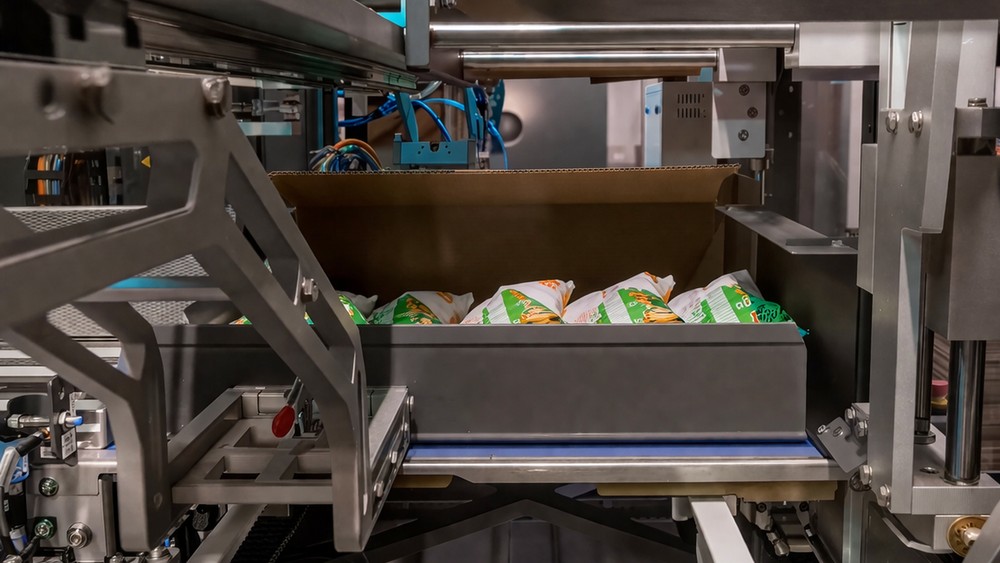

At 03:17 on a Tuesday, the case packer stops again. The HMI shows “Product jam at infeed”. The operator clears a few bags, restarts, and the line is running within minutes. Seemingly, a minor incident, but the same jam has occurred several times a night for weeks, slowly eroding OEE and increasing stress on the team. For many food producers, this is what downtime really looks like: not dramatic breakdowns, but a long series of small, recurring errors that are hard to explain and even harder to prevent.
The problems are familiar:
-
Product and format variation
-
Overfilled bags, new film with different friction or seasonal product sizes make the infeed unstable. The machine is within specification, but certain SKUs or case patterns are more sensitive and generate more stops.
-
-
Cardboard and consumables
-
A weaker corrugated batch, glue temperature drift or slightly off die-cuts cause poor case forming, misfolded flaps or dropped cases in the closing station.
-
-
Sensor and timing issues
-
Dust on a photo-eye, a shifted reflector or tight thresholds for vacuum detection can trigger false rejects, unnecessary stops or speed reductions.
-
-
Changeover and setup
-
Some settings remain manual: guides, magazines, label positions. Under time pressure, each operator uses their own “recipe”, leading to inconsistent performance between shifts.
-
-
Maintenance postponed
-
A chain that needs tensioning, worn suction cups or grippers out of calibration rarely fail at once. Instead, they create more micro-stops and quality issues until a real breakdown forces intervention.
-
Each incident triggers alarms and downtime, but the underlying pattern often remains unclear. Root cause analysis is frequently based on whiteboards, shift notes and the experience of a few key people.

Why packaging line problems are hard to prevent
Several types of modern packaging equipment are IIoT-ready, with extensive sensors, data access and remote connectivity. The challenge is not the lack of data, but the lack of usable insight. Alarm lists are long and lack context. At the same time performance data is scattered across PLC logs, spreadsheets and local SCADA. Video, if it exists, is not synchronised with events, whilst OEM support is mostly reactive, triggered when the situation is already urgent.
As a result, “small” problems become chronic. Everyone knows that “Line 3 is tricky on night shift with the 18-pack”, but there is no structured way to prove it and fix it permanently.
How iNSIGHT helps reduce stoppages
iNSIGHT is Tronrud Packaging’s digital support platform that turns machine data into actionable information for operators, maintenance and management. We may group the contribution from iNSIGHT into three areas.
1. Making patterns visible
iNSIGHT continuously collects key machine data: states, stop reasons, counters, and selected sensor values. This is converted into dashboards and histories rather than raw logs. Over time, you can see:
-
which SKUs or case sizes cause more micro-stops
-
how stop frequency changes with speed or shift
-
whether certain alarms cluster around specific time windows
This moves the conversation from “we think this format is problematic” to “we see a higher stop rate on this format under these conditions”.
2. Adding video and remote expertise
Mechanical problems are often best understood visually. With iNSIGHT, camera systems can monitor critical zones and link video clips to alarms or time stamps. When a jam occurs, the team can replay the seconds before the stop and, if needed, share this directly with Tronrud service through secure remote access.
Instead of trying to describe complex motions over the phone, both sides can look at the same evidence. This shortens troubleshooting and supports more precise adjustments.
3. Supporting predictive and prepared maintenance
iNSIGHT stores historical data, making it possible to detect gradual changes in certain functions. This way, maintenance can act before symptoms turn into unplanned downtime. This allows
-
planning maintenance during scheduled stops
-
ordering spare parts in advance
-
preparing OEM service visits with shared data and clear hypotheses
This video gives you a perception of iNSIGHT:
If you prefer to read: How to Increase OEE on Secondary Packaging Lines
From firefighting to controlled performance
For a production manager or maintenance manager, the main benefit of iNSIGHT is a more predictable line. Recurring errors become visible, easier to diagnose and quicker to stabilise. Operators gain a clearer understanding of cause and effect, and collaboration with the OEM becomes structured and data-driven rather than purely reactive.
The machines remain the heart of the investment. iNSIGHT simply provides the transparency needed to move from repeated 03:17 stops to a controlled, continuous improvement process on the packaging line.