In the snack industry, end-of-line packaging is rarely static for long. Retailers and brand owners frequently adjust how products should appear in store, and those requirements often travel upstream fast, forcing you to adapt just as fast.
A producer may receive a new specification from an end customer and suddenly need to deliver mixed flavours in the same case, in a display-ready format, on a timeline measured in weeks rather than months.
This kind of request is not unusual. What makes it challenging is the combination of constraints:
-
one production line
-
limited internal engineering bandwidth
-
packing system originally configured for single-variant cases
When the market changes quickly, the practical question becomes clear:
How can a packing line be adapted to a new case pattern with small resources and minimal disruption?

The problem: mixed cases from a single line with strict retail presentation
A typical snack plant runs one variant at a time. Bags leave the primary packaging line as a continuous stream of the same flavour, and the end-of-line system groups them into cases or trays.
When an end customer requests mixed cases, the simplest idea is often to run one flavour, then the next, and combine them. That only works when the line can feed two product streams into the case packer at the same time, or when there is buffering and controlled merging available.
One of our customers faced a challenge in packaging a shelf-ready, tear-open display case intended to go directly onto the store shelf. The display function introduced a non-negotiable presentation rule: two different flavours needed to be visible side-by-side when the case was opened and positioned in retail. The target pattern was a total of 14 bags, arranged as two rows of seven bags, one row per flavour.
With only one production line, a fully automatic two-stream feed was not available. At the same time, a manual “batch in blocks” method, feeding seven bags of flavour A then seven bags of flavour B, was impractical to execute consistently at speed.
The constraint was not only output, but also repeatability and correctness. A mixed case arriving with the wrong visible order would not meet the retail requirement.
Useful reading: How to reduce packaging time downtime
The principle: solve the mixing first, then make the case handling fit
When timelines are short and resources are limited, the fastest route is often a staged approach:
-
establish a robust method to achieve the required product sequence, even if part of it is manual
-
implement targeted mechanical and software changes so the machine can build the new pattern reliably
A semi-automatic feeding strategy can be an effective bridge. Instead of trying to merge two full production streams, the incoming flow is alternated. An operator inserts the second flavour in between bags from the running flavour, creating an A, B, A, B sequence. This reduces the complexity of “mixing” to a controlled input rhythm that can be executed with minimal additional equipment.
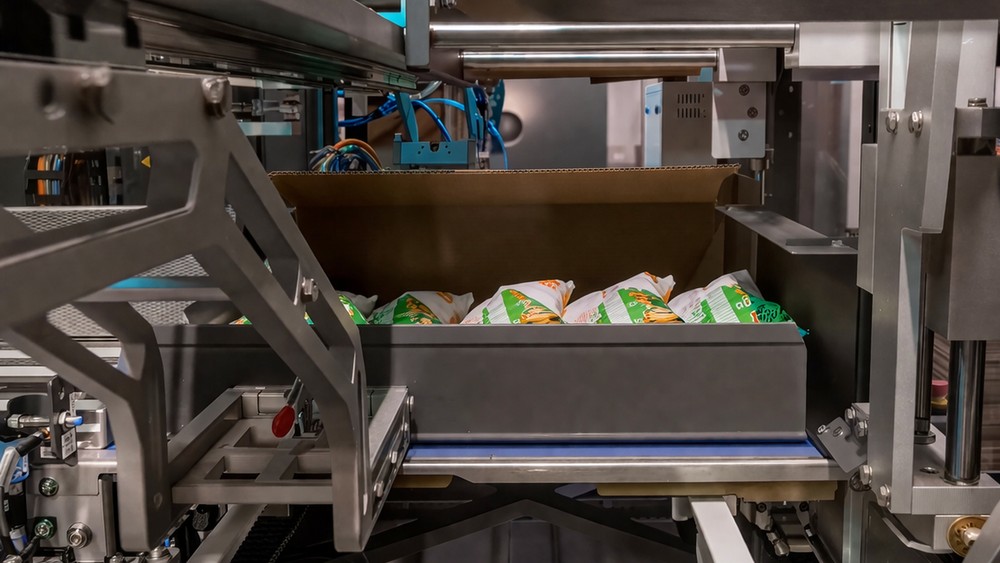
The automated end-of-line system then takes responsibility for grouping and placing bags so that one flavour ends up consistently on one side or row, and the other flavour on the opposite side or row, matching the retail-facing presentation.
More to read: Handling challenging growth
The machine changes: small modifications with high impact
Once the feed concept is defined, the packaging machine must be able to:
-
build a narrower and more specific pattern
-
handle the case in a way that supports the required orientation and placement
-
perform this without introducing instability, excessive footprint, or long changeover
Packaging upgrades to comply with retailers’ demand:
1) Pattern builder improvementsThe pattern builder is adjusted to create the new case configuration. In practice, that means enabling a different grouping logic and tighter control of how bags are accumulated and pushed into the case. For a two-row, seven-and-seven pattern, the machine must consistently build the rows and maintain the correct separation between the two flavours. 2) Case orientation handlingDisplay-ready requirements often depend on how the case will be opened and viewed. When the case is presented on shelf, the “front” is defined by the retailer’s display orientation, not by what is easiest for the packing line. Adding a case rotation step, typically a 90-degree turn before filling, can align the packing direction with the retail-facing direction. That helps ensure the two flavours appear as intended once the case is torn open. 3) Integration of case rotation equipmentA case turning unit can be added upstream of the filling sequence, rotating each case before it receives product. This is a relatively compact intervention compared to redesigning the full case handling section, and it can often be integrated into existing platforms with limited downtime. |
Agility under end-customer pressure
End-customer demands are increasingly shaping secondary packaging, particularly in categories like snacks where shelf visibility and assortment presentation matter. Mixed cases in shelf-ready formats support retail execution, but they also force changes upstream in how factories collate, orient and pack products.
The key lesson is that rapid change does not always require a full rebuild. When resources are tight, a pragmatic combination of semi-automatic mixing and focused machine modifications can deliver a workable solution quickly.
Pattern builder updates, case orientation control, and a simple rotation module can be enough to bridge the gap between an existing line setup and a new retail-driven packing specification.
If you would like to explore how similar pattern changes could be handled in your site, specialists can provide input on feasible approaches based online constraints, required presentation, and the level of automation that makes sense for your volumes and timeline.
Go here to get in touch with ur packaging experts ->